


Creatine is one of the most researched dietary supplements in the world. This powerhouse supplement was once seen mainly in the gym crowd, and it’s now gaining momentum for women’s health and wellness.
As a Naturopathic doctor and Menopause Society Certified Practitioner, creatine is not new in my books. I first learned about creatine for use in athletes and bodybuilders, but as my practice began to shift towards menopausal support, I started seeing huge benefits in women over 40 going through the perimenopausal and post menopausal transition. Keep reading for a deep dive into the specific benefits, dosing regimes and strategies for creatine supplementation for women 40+.
What is Creatine?
Creatine is a natural compound found in the body, made up from the amino acids arginine and glycine. It is primarily synthesized in the liver and kidneys. The remainder of the creatine requirements must be obtained from the diet, primarily through meat and fish. The majority of creatine is stored in skeletal muscle (95%), with the remainder being found in the heart, brain and testes. The body utilizes about 1-2% of muscular creatine daily, which is secreted in the urine.
Creatine Supplementation in Women vs. Men
A 2016 comprehensive review (Ellery 2016) outlined the sex-based difference in the production and storage of creatine in men and women. Women are found to have a lower endogenous production of creatine (what our body can make) and a lower dietary intake in comparison to men. This article also highlighted the serious lack of research on creatine in women throughout various life stages and the poor quality of research in relation to its hormonal influences.
What Are The Benefits of Creatine in Women Over 40?
- Preserving Muscle Mass and Strength: Fluctuating hormones, especially lower estrogen, progesterone, and testosterone levels for women in their 40s, can lead to a loss of muscle mass and strength. Creatine, especially when combined with resistance training, may help mitigate this muscle loss and promote muscle strength and subsequently improve metabolic health.
- Improving Bone Health: Women hit their peak bone mass around age 30 and see a slow decline after that. Due to hormone fluctuations in their 40s, we see a significant risk of bone turnover and loss, especially when a woman starts losing her period more frequently. In combination with the muscle-enhancing effect, research suggests that creatine can positively influence bone mineral density when paired with resistance exercise.
- Reducing Fatigue & Improving Sleep: Fatigue is one of the most common complaints of women in their 40s. Kids + life stress + hormone changes = no sleep. Creatine can help reduce fatigue by increasing energy availability in cells, which is particularly beneficial during hormonal fluctuations. Supplementation with creatine is also likely to support greater workout intensity and volume, recovery quality, and sleep duration following resistance training.
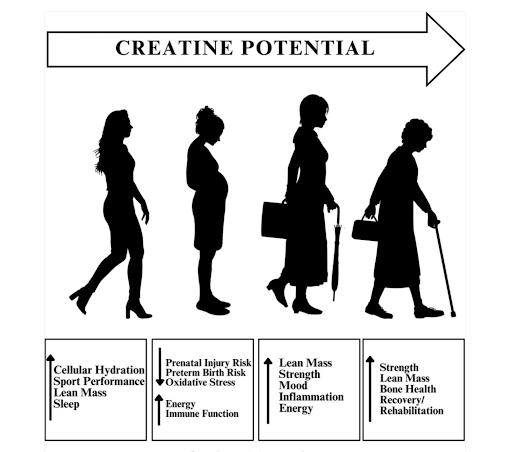
- Brain Fog & Cognitive Changes: Forgetfulness, foggy brain, memory lapses and difficulty concentrating are very common symptoms during perimenopause. Creatine’s role in ATP regeneration can benefit brain function, potentially improving cognitive performance and reducing mental fatigue.
- Supporting Mood: Mood swings and emotional changes are common during perimenopause. Creatine may help support a more stable mood balance and reduce symptoms of anxiety.
- Performance Enhancement, Injury Prevention & Recovery: Creatine helps replenish your body’s energy stores, allowing you to stay strong and active during exercise. For women over 40, it can support muscle tone, faster recovery, and bone strength, helping reduce the risk of fatigue and injury.
How To Take Creatine For Women 40+: A Simple, Effective and Safe Dosing Strategy
1. Opt for the slow loading dose method:
There are two methods commonly used to increase intramuscular creatine levels:
- Slow loading dose
- Fast loading dose
Both methods are effective, one just gets you there a bit quicker. The fast loading dose recommends taking up to 20 grams of creatine per day (or ~0.3g/kg of body weight) in divided doses for approximately 5-7 days. The slow loading dose recommends around 3-5 grams per day (or ~ 0.05-0.15 g/kg of body weight per day) for a minimum of 1 month.
In certain health conditions and populations, such as high-level athletes, vegetarians, people starting an intensive fitness regimen, or in post-concussion protocols, the fast dosing regimen may be required. However, for women over forty looking to start a creatine protocol, the slow loading dose is recommended.
2. Commit to creatine for the long run: find a way to stay consistent with your regimen
For women over forty, creatine can be a game-changer if it’s taken for the right duration of time. Just like any other supplement, you might get bored, uninterested and let it start to collect dust in your cupboard. Ladies, if you want to actually see the benefits of creatine, you need to commit to a consistent regimen for a minimum of 60 days.
- Add creatine to your coffee: A performance blend to boost your morning workouts. Yes, you can add it to your coffee in the morning. I know for my patients, coffee is a staple in the morning, so it’s an easy way to get your creatine in. According to a 2016 review from the Journal of Strength & Conditioning Research, creatine and caffeine do not have any significant interactions or issues when ingested together at the same time. However, keep in mind that if you have a sensitive stomach, you may want to skip the coffee or add-ins (milk/sugar).
- Mask the taste: Blend Creatine with your favourite drink or drink mix. This helps you stay hydrated and improves the taste profile. Unfortunately, Creatine does not have much of a flavour/taste, and some people don’t enjoy the aftertaste. An easy way to get over this hump is to mix it with a flavourful electrolyte or greens powder to help offset the taste and support hydration. We recommend electrolytes such as No Days Wasted or Younited greens superfood powder.

- Don’t get caught up in when to take it, just take it. The timing of creatine ingestion is another common question I get from my patients. In an ideal world, you should aim to take your creatine post-workout, as this method is superior to pre-workout ingestion for optimizing body composition and strength. But for women 40+ who are running around and have 100 things on their plates, time is a very real limitation. So my suggestion is to take it when you remember and when it works for your schedule. The differences in benefit are so minimal, and the research is still considered somewhat mixed regarding timing.
What About Side Effects?
A recent statement (February 2025) from the International Society of Sports Nutrition (SSN) in response to restrictions on creatine supplementation marketing and manufacturing stated the following: “Creatine supplementation is safe, beneficial throughout the lifespan and should not be restricted”. Why is it possible for the ISSN to make such a broad and conclusive statement about creatine supplementation? The simple answer: Research.
Creatine is one of the most well-researched supplements on the planet. Since the 70s, there have been over 680 peer-reviewed clinical trials on the safety and efficacy of creatine supplementation in a wide range of participants (of varying age, sex, etc), doses, and health conditions. In all of these trials, no adverse effects were reported, alongside very minimal side effects.
One of the most common questions I get from my female patients is:
Will creatine make me gain weight?
No, creatine will not cause weight gain. It can, however, result in a subtle increase in intramuscular fluid retention upon initial supplementation, which can potentially make a woman feel like she has gained weight. This potential side effect typically subsides after consistent supplementation and with adjustment of the dosage.
Creatine works by increasing muscle mass, so in many clinical trials, we do see an increase in lean muscle mass. In one study, women supplementing with creatine while participating in a resistance training program saw a 1.79kg (~4 pound) increase in muscle mass in comparison to the placebo group (Desai 2025).
Can Creatine worsen fluid retention/bloating symptoms of PMS?
You may be feeling apprehensive about taking a creatine supplement because you have heard it can potentially increase water retention, which is a problem because that issue seems to get much worse before you get your period. Fair enough, but one small study actually found a surprising result when looking at creatine and fluid retention across the menstrual cycle: In a group of 43 active, young women, researchers discovered that despite an increase in total body water during the luteal phase of the menstrual cycle, there was no significant increase in body mass. In fact, the increases in total body water during the luteal phase related to creatine supplementation was actually also associated with an improved hydration status. This is because luteal phase hormone shifts are associated with an increase in EXTRAcellular fluid (outside our cells), vs creatine works by increasing fluid going INTO the cell, thus actually improving fluid balance throughout the menstrual cycle.
In summary, it appears creatine may be an especially effective intervention for improving cellular health and hydration during menstruation and in the luteal phase. However, If you are someone that gets bloated prior to menstruation you can reduce the dose of your creatine to help potentially offset any of these adverse effects.
Creatine and kidney function
A 2019 systematic review and meta analysis (eSilva 2019) on the impact of creatine supplementation on renal function found that creatine did not impact blood creatinine levels or urea levels. The meta-analysis also concluded that creatine supplementation does not induce kidney damage in the recommended dosages and durations of supplementation.
Key Takeaways:
The benefits of creatine supplementation for women throughout their lifespan outweigh any minimal adverse effects. Benefits include positive changes to cognitive function, mood balance, energy status, exercise performance and recovery, bone health, immune health and inflammation.
Adverse effects of creatine supplementation for women can be mitigated by utilizing a slow and low loading dose protocol, based on tolerance to supplementation and body weight.
Creatine monohydrate supplementation in recommended dosing regimes and forms is safe, always talk to your healthcare provider, such as a naturopathic doctor, before initiating any new supplements.
References
Candow, D. G., Desai, I., Pandit, A., Smith-Ryan, A. E., Simar, D., Kaakoush, N. O., & Hagstrom, A. D. (2025, March 19). The effect of creatine supplementation on lean body mass with and without resistance training. Nutrients, 17(6), Article 1081. https://doi.org/10.3390/nu17061081
de Guingand, D. L., Palmer, K. R., Snow, R. J., Davies-Tuck, M. L., & Ellery, S. J. (2020, June 15). Risk of adverse outcomes in females taking oral creatine monohydrate: A systematic review and meta-analysis. Nutrients, 12(6), Article 1780. https://doi.org/10.3390/nu12061780
Ellery, S. J., Walker, D. W., & Dickinson, H. (2016, August). Creatine for women: A review of the relationship between creatine and the reproductive cycle and female-specific benefits of creatine therapy. Amino Acids, 48(8), 1807–1817. https://doi.org/10.1007/s00726-016-2199-y
Forbes, S. C., Cordingley, D. M., Cornish, S. M., Gualano, B., Roschel, H., Ostojic, S. M., … Roy, B. D. (2022, February 22). Effects of creatine supplementation on brain function and health. Nutrients, 14(5), 921. https://doi.org/10.3390/nu14050921
Gordon, A. N., Moore, S. R., Patterson, N. D., Hostetter, M. E., Cabre, H. E., Hirsch, K. R., … & Smith-Ryan, A. E. (2023). The effects of creatine monohydrate loading on exercise recovery in active women throughout the menstrual cycle. Nutrients, 15(16), 3567.
Kreider, R. B., & Stout, J. R. (2021, January 29). Creatine in health and disease. Nutrients, 13(2), 447. https://doi.org/10.3390/nu13020447
Kreider, R. B., Kalman, D. S., Antonio, J., Ziegenfuss, T. N., Wildman, R., Collins, R., Candow, D. G., Kleiner, S. M., Almada, A. L., & Lopez, H. L. (2017). International Society of Sports Nutrition position stand: Safety and efficacy of creatine supplementation in exercise, sport, and medicine. Journal of the International Society of Sports Nutrition, 14, Article 18. https://doi.org/10.1186/s12970-017-0173-z
Ostojic, S. M., Stea, T. H., Ellery, S. J., & Smith‐Ryan, A. E. (2024). Association between dietary intake of creatine and female reproductive health: Evidence from NHANES 2017–2020. Food science & nutrition, 12(7), 4893-4898.
Smith-Ryan, A. E., Cabre, H. E., Eckerson, J. M., & Candow, D. G. (2021). Creatine supplementation in women’s health: a lifespan perspective. Nutrients, 13(3), 877.
Smith-Ryan, A. E., DelBiondo, G. M., Brown, A. F., Kleiner, S. M., Tran, N. T., & Ellery, S.
J. (2025). Creatine in women’s health: bridging the gap from menstruation through pregnancy to menopause. Journal of the International Society of Sports Nutrition, 22(1), 2502094.
Vanakoski, J., Kosunen, V., Meririnne, E., & Seppälä, T. (1998). Creatine and caffeine in anaerobic and aerobic exercise: Effects on physical performance and pharmacokinetic considerations. International Journal of Clinical Pharmacology and Therapeutics, 36, 258–262.

