I was standing in the mall, wandering, genuinely not knowing where to shop anymore.
I couldn’t walk into Aerie or American Eagle — that wasn’t me, hadn’t been for years. But I also wasn’t ready for Reitmans. And since there’s no more Bay… who even was I? I tried Zara, and somehow everything fit different. Overnight. The sizes I used to wear just weren’t a thing for me anymore. It hadn’t happened gradually. It felt like I’d looked up one day and something had already changed.
I stood there and asked myself: when did this start happening?
I Thought I Knew What This Was
Here’s the part that still catches me off guard when I tell it: I talk about hormones and menopause all day. With patients. With friends. So when something started shifting in myself and in my relationship more noticeably these past couple of years, I told myself I already knew exactly what it was.
I’d been calling it postpartum. I kept trying to get back to who I was before my first — the body, the wardrobe, the version of myself I assumed was still in there, just waiting for me to find my way back to her.
But she wasn’t there to get back to anymore. That wasn’t postpartum. That was something else entirely, and I didn’t have a name for it yet.
The Language I Didn't Have
I didn’t understand how to feel feminine. Or sexy. Or even just like myself. And I’m still learning that language, slowly, cautiously, not all at once. Some days I still don’t have the words for what’s shifting. I’m not writing this because I’ve figured it out. I’m writing it because I haven’t, and I think that’s actually the point.
I Wasn't the Only One
The more I talked about it with friends, and with patients in the same bracket, mid to late 30s, the more I realized we were all describing the same gap. Not postpartum. Not perimenopause. Something in between, with no name, no roadmap, and no rhythm yet.
That’s when it stopped feeling like my problem and started feeling like a stage. And stages are worth understanding properly, not just pushing through.
Life in Three Acts
There’s a way of thinking about life as a play in three acts. Act One is where the story gets set and the characters get built. Act Two is where the conflict shows up — the climax, the growth. The main character has to learn something and come out the other side changed. Act Three is the wisdom: everything the first two acts built toward.
Your 30s are the opening of Act Two.
And the opening of Act Two is intense. You’re stepping into roles you’ve never played before like mom, wife, leader, and caretaker, sometimes all in the same hour. There’s no established rhythm yet. You’re building the choreography while you’re already on stage. Of course it feels like a lot. It is a lot.
It's Not Just Your Hormones
So we look for one explanation. Usually it’s hormones, and yes, they’re part of it. But that’s not the whole story.
Your body also has less resilience right now for what this act is actually demanding: the stress, the sleep deprivation, the constant switching between roles with no recovery time in between. Less resilience doesn’t mean something’s broken. It means the demand went up.
And underneath the hormones, underneath the resilience, there’s something bigger happening — an identity shift. You’re not who you were in your 20s. You’re not who you’ll be in twenty years, either. You’re becoming someone new, in real time, while still doing all the things that new someone hasn’t figured out yet.
This is where the conversations I have most often go sideways, where a real experience gets flattened into one of two boxes. Either “something’s wrong with your hormones, here’s a fix,” or “you’re too early for that, come back later.” Both skip the part where you actually get to explore what’s changing and why.
Something to Navigate, Not Fix
Here’s what I’ve come to believe, in myself and in every conversation I’ve had since: this isn’t something broken that needs fixing. It’s a transition; one you learn to navigate, not solve.
Which brings me back to the mall.
No one told me I couldn’t shop at Aerie or American Eagle anymore. I still could. It just didn’t let me express how I felt right now. Nothing was “wrong.” I just hadn’t found what fit yet.
That’s what this whole stage is like internally, too. We’re so quick to want to fix it with one answer, one label, one supplement. But this isn’t a problem to solve. It’s a stage to get curious about and to try things on, literally and internally, until something actually fits who you are now. And how you navigate it shapes how you show up in every single role you play.
What Slips Away in the Chaos
And in the middle of all of that — the roles, the stress, the constant switching, the trying-on — one of the first things that quietly slips away is desire.
Desire to connect. To feel loved. To feel pleasure. To have intimacy.
We don’t lose it dramatically. It just gets deprioritized, quietly, the way everything else about ourselves gets deprioritized in this act. And putting it back, treating pleasure as a priority instead of an indulgence, is actually one of the things that starts to dismantle the guilt we feel when we choose ourselves, and our relationships, first.
That’s the conversation I want to keep having. Not because I have it figured out, but because I’m in it, and I know there are a lot of you in it too.
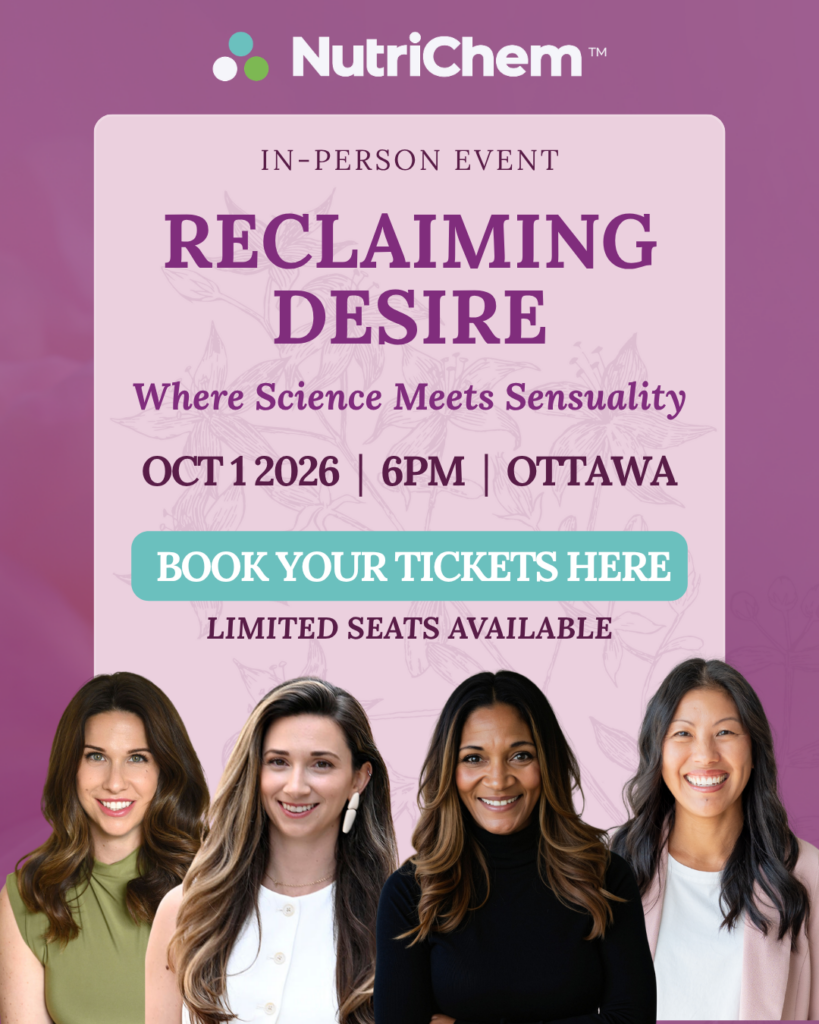
If this is you, if you’ve felt this shift and couldn’t quite name it, come talk about it with us. October 1st, in person, at Reclaiming Desire: Where Science Meets Sensuality. Visit our event page to save your seat.
You’re not too early. You’re not broken. You’re just in the in-between. And you’re not alone in it.