
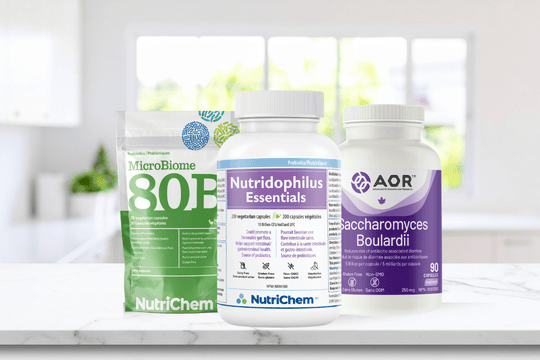
A common questions I get is: "What's the best probiotic?" The honest answer? It depends on what you're trying to accomplish.
Probiotics aren’t all the same. Different strains, different potencies, and different clinical situations call for different tools.
Here’s how I think about it in practice.
1. Nutridophilus: My Everyday Workhorse
If probiotics were cars, Nutridophilus would be the reliable Toyota that never seems to quit.
It’s been a NutriChem staple for nearly 30 years and contains four Lactobacillus strains that support digestive and immune health. It’s shelf-stable, travel-friendly, and gentle enough for the whole family.
I commonly recommend it for:
- Everyday digestive health (daily probiotic)
- Gas and bloating (i.e. after a huge meal!)
- Travelling
- Kids and families
- General microbiome maintenance
- People new to probiotics
I personally view Nutridophilus as a “foundational probiotic.”
Not everyone needs the biggest, strongest probiotic on the shelf. Many people simply need a consistent daily probiotic that helps keep their microbiome pointed in the right direction.
Adam's Bottom Line: If you're healthy and looking for a daily probiotic, start with Nutridophilus.
2. Microbiome 80B: The Heavy Hitter
Microbiome 80B is a very different product. It is more of a “clinical-strength” probiotic.
Instead of 10 billion CFU from four strains, it delivers 80 billion CFU from nine strains, including both Lactobacillus and Bifidobacteria species.
This higher-potency, broader-spectrum probiotic formulation makes it one of my favourite choices when I want to aggressively restore the microbiome.
I commonly recommend it for:
- Post-Antibiotic Use
- Significant Digestive Disfunction
- Long-standing microbiome disruption
- Chronic bloating
- People looking for a higher-potency probiotic
When someone tells me they’ve been on multiple rounds of antibiotics, had a rough stomach bug that they’re recovering from, or just feel like their digestion has never quite been the same since “that weird thing that happened a few years ago,” this is often where I start.
Adam's Bottom Line: When the microbiome needs rebuilding, Microbiome 80B is usually my first choice.
3. Saccharomyces Boulardii: The Traveller's Best Friend
S. Boulardii is interesting- it isn’t actually a probiotic bacteria at all.
It’s a beneficial yeast that is particularly effective at reducing diarrhea and loose stools. Sort of like a milder, natural form of Imodium (loperamide).
And it has some other useful and interesting properties as well- for example, because it’s a yeast, antibiotics don’t really kill it, which can make it useful antibiotic-associated diarrhea as well.
I commonly recommend it for:
- Traveller’s diarrhea
- Antibiotic-associated diarrhea
- Acute stomach bugs
- During antibiotic treatment
- Individuals prone to loose stools and diarrhea
If you’re heading to Mexico, the Caribbean, South America, or anywhere that tends to upset your digestive tract, S. boulardii is always on my shortlist. And it works very well in combination with Nutridophilus for traveler’s diarrhea!
It’s also one of my favourite options during an active gastrointestinal infection because it works differently than traditional probiotics
Adam's Bottom Line: For stomach bugs, travel, or diarrhea, S. boulardii is often my MVP (and it combines very well with Nutridophilus!).
So Which One Would I Pick?
Everyday maintenance?
Just finished antibiotics?
Stomach flu or traveller’s diarrhea?
Chronic digestive issues?
- Usually Microbiome 80B
Kids needing a simple daily probiotic?
At the end of the day, probiotics are tools. The goal isn’t to find “the best probiotic.” The goal is to find the right probiotic for the right person at the right time.
And that’s where a little professional guidance can make all the difference.