

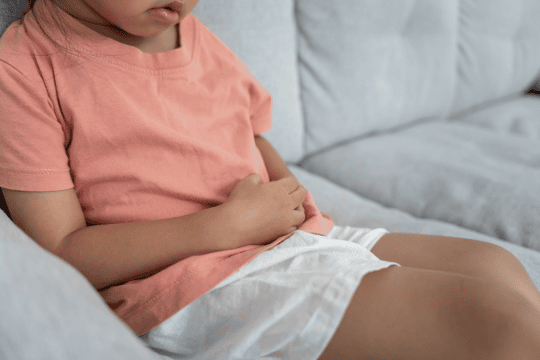
Constipation is common, and when it's missed or not treated well, it can ripple into other areas of a child's life.
What is constipation?
Constipation can be about frequency of bowel movements. But it can also be about hard, painful, or difficult-to-pass stools, or incomplete evacuation of hard stools regardless of how frequently they happen.
Why Does It Happen?
It most commonly starts when:1
- A child has one painful poo and begins holding it in to avoid the pain again
- The bowel fills up and stretches, the urge fades, the stool hardens, and the cycle repeats
- Diet changes occur, like introducing solids or switching to cow’s milk
- Stress happens during toilet training
- A child starts school, where using the bathroom feels uncomfortable
- There isn’t enough fluid intake
- There isn’t enough fibre from fruits, vegetables, and whole grains
This can result in a vicious cycle where avoiding the washroom makes the problem worse, which makes avoidance more likely.1
Signs Your Child May Be Constipated
- Fewer than 2 bowel movements per week
- Straining, crying, or reporting pain
- Hard, dry, or lumpy stools
- A big, uncomfortable tummy
- Soiling of underwear (often a sign of overflow, where liquid stool leaks around a hard blockage, not a hygiene issue)
- Behaviour suggesting “holding it in”: squatting, rocking, stiffening, walking on tiptoes, crossing legs, or pressing heels against the perineum
- Reduced appetite
When Should You See a Doctor Right Away?
Seek prompt medical evaluation if your child has any of the following:
- Fever, abdominal distention, weight loss, or poor weight gain
- Bloody stool or bloody diarrhea
- Very thin, ribbon-like stools
- A swollen belly with vomiting
- Intermittent diarrhea and explosive stools
- Leg or muscle weakness
These can occasionally point to a condition that needs specialist attention.
How to Support Regular, Comfortable Bowel Movements
The goal in treating constipation is to combine strategies to produce soft, painless stools and prevent stool from building up again.
Education First
Walking through the mechanics of digestion can help your child understand what’s happening with food, the urge to go, and defecation. It also explains why holding things in can feel better in the moment but worsens the situation over time, and why overflow soiling develops.
Behavioural Strategies
Behavioural and lifestyle approaches work best when combined.
- Establish a toilet routine. Sit on the toilet about 5-10 minutes, within 1 hour of meals (especially breakfast and dinner), as eating triggers the bowel to contract.
- Use a footstool so your child’s feet are supported. This naturally relaxes the pelvic floor muscles and makes passing stool easier.
- Make it comfortable. A book, song, music, or encouragement can be a helpful tool to reduce pressure.
Focus on Food
Eating enough fibre-rich food is a cornerstone of good bowel health. It helps hold water and soften the stool to support bowel regularity.
Great fibre-rich foods for kids include:
- Fresh or dried fruits: prunes, pears, kiwi, apples, figs
- Vegetables: broccoli, peas, carrots, sweet potato
- Whole grains: oats, wholegrain bread, brown rice
- Legumes: lentils, chickpeas, baked beans
Daily fiber goals depend on age:2
- Children 1-3 years of age: 19g
- Children 4-8 years of age: 25g
- Children 9-13 years of age: 31g (boys), 26g (girls)
- Children 14-18 years of age: 38g( boys), 26g (girls)
A short 2-week trial removing milk or egg from the diet can help clarify whether your child is reacting to a specific food.
Drink Enough Water
Dehydration makes stools harder and more difficult to pass. Ensure your child is drinking water throughout the day. Here is the recommended total daily water requirements for each age group:
- Children 1-3 years of age: 1.3L
- Children 4-8 years of age:1.7L
- Children 9-13 years of age: 2.4L (boys), 2.1L (girls)
- Children 14-18 years of age: 3.3L (boys), 2.3L (girls)
Total water includes drinking water, water in beverages, and water that is part of food, not water intake alone.
Keep Them Moving
Physical activity directly stimulates the gut. Regular movement, even just walking, playing outside, or dancing in the kitchen, helps keep things moving inside too.
Reach for Supplemental Support if Needed
Soluble Fibre Supplements
Soluble fibres (like psyllium and inulin) hold water in the stool and soften it. They are generally safe and well tolerated in children when introduced slowly with adequate water.3
Magnesium
Magnesium works as an osmotic laxative, drawing water into the bowel to soften stool and can be used when PEG isn’t tolerated or available.4,5
Removing the Blockage (fecal disimpaction)
If a large, hard mass of dry stool is stuck in the rectum or lower colon, stool softeners can often worsen overflow diarrhea if untreated. When present, the first step is to help things move along before focusing on maintenance strategies.
- Polyethylene glycol 3350 (PEG), commonly known as Miralax, is the first-line medication for clearing out a large buildup of stool and long-term maintenance in children of all ages.6
- PEG is well tolerated, tasteless, and doesn’t cause the cramping or “dependency” that many parents worry about with stimulant laxatives.
Other options:7
- Lactulose: if PEG isn’t available or isn’t tolerated
- Stimulant laxatives (like senna or bisacodyl): can be used short-term when PEG or lactulose aren’t enough
- Prolonged use of stimulant laxatives is generally not recommended due to concerns about long-term gut effects
Once the stools are no longer dry, hard or painful, the reduction of these medications can be done gradually while maintaining the previously mentioned lifestyle habits.
The Bottom Line
Constipation in kids is common, treatable, and almost never about anything a parent did wrong. The cycle that keeps it going, pain leading to holding, holding leading to more pain, can feel discouraging from the outside, but it responds well to a steady, layered approach: enough fibre, enough water, a predictable toilet routine, and patience with the process. For some children, that’s the whole plan. For others, it takes a bit more support, whether that’s a fibre supplement or a short course of PEG to clear things out properly before maintenance can even begin.
If your child’s constipation has been going on for a while, isn’t responding to diet and routine changes, or comes with any of the red-flag symptoms above, it’s worth bringing to a naturopathic doctor or your child’s physician. And as always, check in with your ND before starting any new supplement or medication, even ones that seem simple and low-risk.
References
1. Rowan-Legg A, Canadian Paediatric Society, Community Paediatrics Committee. Managing functional constipation in children. Paediatr Child Health. 2011;16(10):661-670.
2. Health Canada. Dietary reference intakes tables: Reference values for macronutrients. July 20, 2005. Accessed August 13, 2026. https://www.canada.ca/en/health-canada/services/food-nutrition/healthy-eating/dietary-reference-intakes/tables/reference-values-macronutrients.html
3. Santucci NR, Chogle A, Leiby A, et al. Non-pharmacologic approach to pediatric constipation. Complement Ther Med. 2021;59:102711.
4. Kubota M, Ito K, Tomimoto K, et al. Lactobacillus reuteri DSM 17938 and Magnesium Oxide in Children with Functional Chronic Constipation: A Double-Blind and Randomized Clinical Trial. Nutrients. 2020;12(1). doi:10.3390/nu12010225
5. Gomes PB, Duarte MA, Melo M do CB de. Comparison of the effectiveness of polyethylene glycol 4000 without electrolytes and magnesium hydroxide in the treatment of chronic functional constipation in children. J Pediatr (Rio J). 2011;87(1):24-28.
6. 2026 Guidelines on Managing Pediatric Constipation. doi:10.1056/CLINgwNA60256
7. Koppen IJN, Lammers LA, Benninga MA, Tabbers MM. Management of Functional Constipation in Children: Therapy in Practice. Pediatric Drugs. 2015;17(5):349-360.

